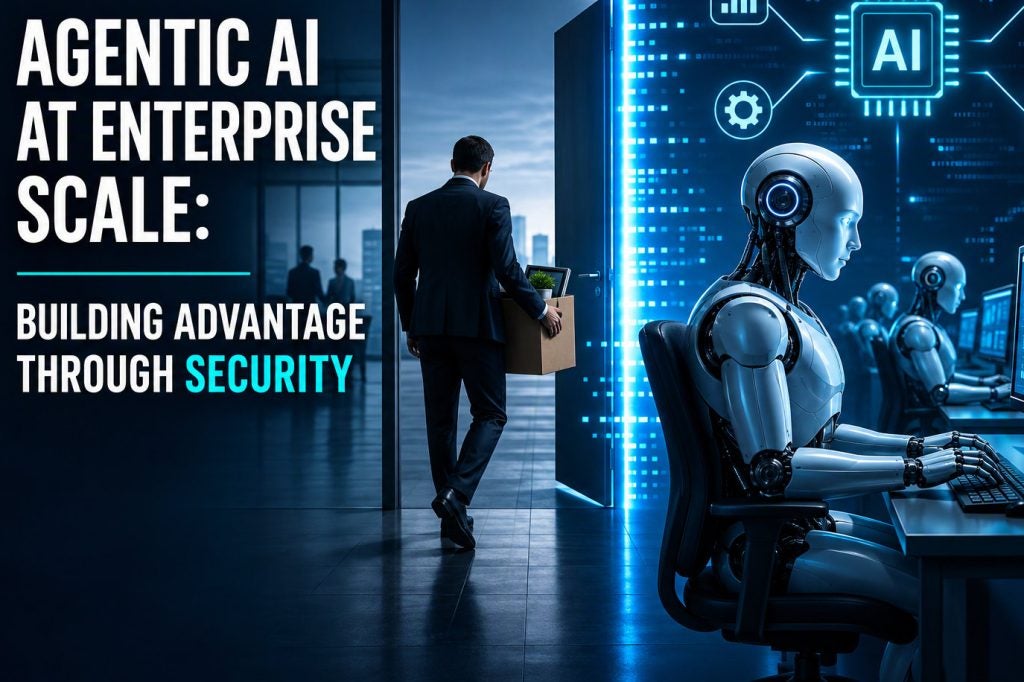
Agentic AI is rapidly crossing a critical threshold. What began as isolated pilots and productivity experiments is now becoming operational infrastructure — systems that can reason, access enterprise data, invoke tools, and act autonomously inside real business workflows. This shift gives enterprises a clear opportunity that is to modernize security alongside innovation. This transition is already reshaping enterprise risk profiles.
According to Gartner, by 2028, 25% of all enterprise generative AI applications will experience at least five minor security incidents per year, up sharply from 9% in 2025. Gartner further projects that 15% of enterprise GenAI applications will face at least one major security incident annually by 2029, compared with just 3% in 2025.
At first glance, these numbers appear alarming. They signal something else entirely, agentic AI is moving from experimentation to production. Security incidents are no longer hypothetical risks, they are the natural byproduct of real usage, real permissions, and real automation at scale.
The organizations that succeed in this next phase will not be those that deploy agentic AI the fastest , but those that scale it safely, confidently, and sustainably.
Enterprise GenAI Security Incidents Are Rising with Adoption
% of Enterprise GenAI Apps with Frequent Security Incidents
2025 | ████░░░░░░ 9%
2026 | ███████░░░ 14%
2027 | █████████░ 20%
2028 | ██████████ 25%
Source: Gartner, 2026
Frameworks such as Model Context Protocol (MCP) are accelerating adoption by making AI integrations faster and more interoperable. While MCP prioritizes developer speed, it also encourages organizations to be deliberate about how security is applied, enabling smarter, use‑case‑driven controls rather than one‑size‑fits‑all restrictions.
Leading organizations are responding by:
- Treating AI agents as non‑human identities with tightly scoped permissions
- Scaling low‑risk, high‑value use cases first
- Assigning domain ownership so business experts define AI guardrails
- Embedding security reviews directly into AI deployment workflows
Across Asia‑Pacific, enterprises are already maturing their AI governance as adoption accelerates. This positions the region well to move from fast deployment to trusted, scalable AI.
AI Governance Maturity in Asia Pacific
APAC Enterprise AI Landscape
AI Adoption (Weekly Use) ██████████ 78%
Informal / Unapproved AI Use ███████░░░ 58%
Workflow Redesign for AI ██████░░░░ 57%
Confidence in AI Security ███░░░░░░░ 24%
Source: BCG, IDC, 2025–2026
Closing this governance gap takes more than technology, it takes people with the right skills. Trainocate offers training that helps teams adopt agentic AI securely and responsibly. The courses below focus on three critical areas: securing AI workloads and non-human identities, managing AI risk across the full lifecycle, and using AI to strengthen security operations.
1. Securing Agentic AI & Non‑Human Identities
SC‑5009: Secure AI Solutions in the Cloud using Microsoft Defender for Cloud and Microsoft Entra
- Focuses on AI workload security, identity controls, and least‑privilege access
- Explicitly covers AI authentication, trust boundaries, and guardrails in Microsoft Foundry
- Strong fit with:
- “Treating AI agents as non‑human identities”
- “Embedding security into AI deployment workflows”

2. AI Risk, Governance & Responsible Scaling
ISACA Advanced in AI Risk (AAIR™)
- Enterprise‑level AI risk management and governance
- Covers risk across the full AI lifecycle: design and procurement, training and testing, deployment, monitoring, and decommissioning
- Advanced credential: learners must already hold a qualifying certification such as CISA, CISM, CRISC, or CISSP
- Strong fit with:
- “Scaling agentic AI safely and sustainably”
- “Assigning domain ownership and defining guardrails”
3. Copilot & Security Operations
SC5006: Enhance Security Operations by using Microsoft Security Copilot
- Shows how AI augments security teams safely
- Reinforces the idea that AI can strengthen security, not weaken it
- Covers Security Copilot agents, including agent identities and permissions — reinforcing the case for treating AI agents as non-human identities
By 2028, success won’t be measured by who adopted agentic AI first, but by who scaled it safely, confidently, and sustainably. When security is designed in from the start, agentic AI becomes not a risk to manage, but a competitive advantage to build on. Security incidents will happen. That is the cost of operational AI.
Ready to scale agentic AI with confidence? Explore Trainocate’s AI security and governance courses, or speak with our training consultants to build a learning pathway that fits your team’s roles, goals, and AI maturity.