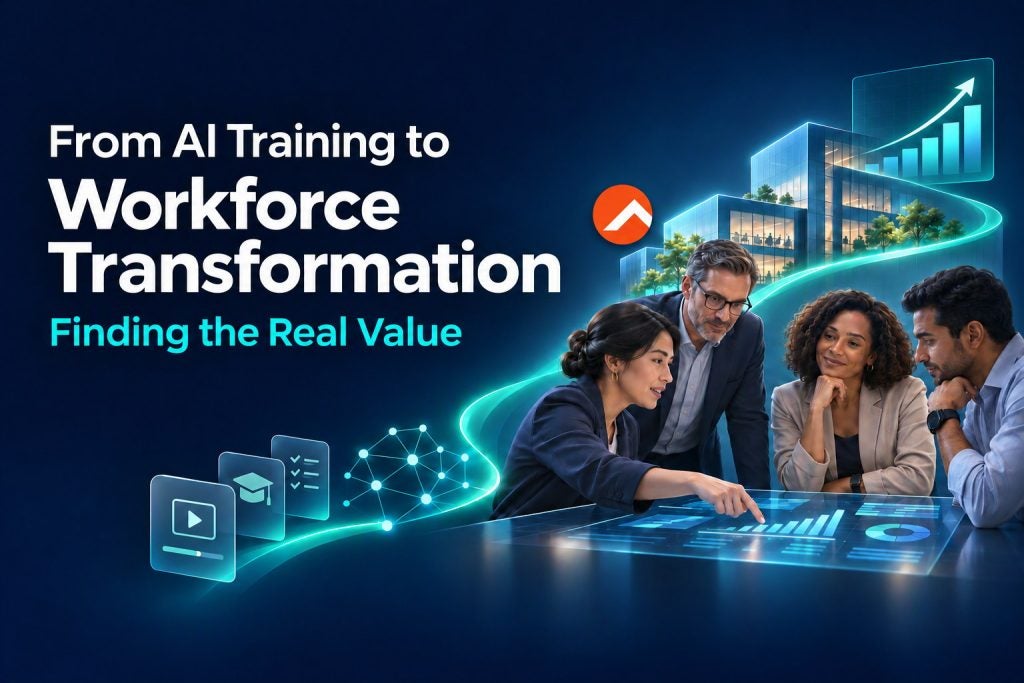
There’s a question that keeps coming up whenever AI skills training is discussed. Are we simply showing people how to use the tools, or are we helping organizations change the way work actually gets done?
That might sound like splitting hairs. In practice, the difference is huge.
Most AI training is built around features. People get a tour of what the tool can do, pick up a few prompting tips, and are encouraged to start using it. That’s useful, but the effect tends to fade once the session is over.
Individuals walk away knowing more, yet the organization rarely ends up any more capable than before. Lasting progress comes when we stop focusing on the tools and start questioning how the work itself is done.
This is what we mean by AI Workforce Performance: turning what AI could do into business results you can actually measure. Asking whether employees know how to use Copilot, for example, no longer gets us very far.
Better questions would be:
How is the work improving?
What new opportunities open up once teams use AI as part of their everyday work?
And how far have companies gone in reshaping their processes to make room for digital labor?
Skills in AI-exposed roles are evolving 66% faster, so organizations and individuals alike need to make continuous learning and structured upskilling a priority if they want to keep up (PwC AI Jobs Barometer 2026)
Five shifts stand out as this change takes hold:
- From Generic Learning to Role-Based Activation
People pick up AI much faster when what they learn is connected to the job in front of them. Someone in finance, HR, sales or operations needs examples drawn from their own work, not broad productivity scenarios that could apply to anyone.
- From Prompting to Work Design
Good prompting helps, but the bigger gains come from building work patterns people can repeat, with clear inputs, outputs, review steps and a named owner. That structure is what makes results consistent and lets them scale.
- From Tool Users to Agent Leaders
Managers and process owners are taking on a different kind of role. Beyond using AI themselves, they are learning to hand tasks to AI agents, decide where the limits sit, check the output, and keep improving teams made up of both people and digital assistants.
- From One-Time Adoption to Continuous Operating Models
Rolling out AI once and moving on rarely works. Lasting impact depends on continued support, internal champions, regular feedback, and governance that keeps everything on track.
- From Activity Metrics to Value Outcomes
Usage numbers on their own prove very little. Organizations need to tie AI adoption to outcomes they can see, such as shorter cycle times, better quality, lower costs and more capacity. Value has to be shown, not assumed.
Building an AI-powered workforce has little to do with replacing people and a lot to do with changing how people work with technology. That takes clear accountability, sensible governance, and the right balance between human judgment and what machines do well.
The Workforce Evolution: AI’s Quiet Coup – According to the International Monetary Fund, AI could affect up to 40% of jobs worldwide, lifting productivity while changing the skills and requirements those roles demand.
Some of Trainocate’s AI training programmes
Below are a few of Trainocate’s most popular AI programmes, each designed to help professionals build practical AI and Generative AI skills:
AI & Generative AI Essentials
Generative AI Essentials on AWS
An entry-level course for business and technical professionals covering Generative AI concepts, foundation models, prompt engineering, responsible AI and AWS AI services. A good starting point for anyone new to AI.
Introduction to Generative AI
A one-day introduction to AI, machine learning, deep learning and Generative AI, with a clear look at how GenAI is changing the way businesses operate.
AI for Builders & Developers
Building & Deploying Generative AI Models
A practical, intermediate-level course on machine learning pipelines, Amazon SageMaker, foundation models, LLMs, Amazon Bedrock, and building AI applications for real-world use.
Developing Generative AI Applications on AWS
Build and deploy GenAI applications with AWS services including Amazon Bedrock and Amazon Q, through hands-on labs based on business use cases.
Building Intelligent Applications with Generative AI
An advanced programme covering prompt engineering, LLMs, fine-tuning foundation models, bringing AI into business workflows, and creating intelligent applications powered by AI.
AI Certification Pathways
AWS Certified AI Practitioner (AIF-C01)
For professionals who want a solid grounding in AI and machine learning, along with a certification the industry recognises.
AWS Machine Learning Engineer – Associate
For practitioners who build, deploy and manage machine learning solutions on AWS and want a certification to back up their expertise.
Microsoft Azure AI Fundamentals (AI-900)
An introduction to AI workloads, machine learning, computer vision, natural language processing and responsible AI on Microsoft Azure.
Designing and Implementing a Microsoft Azure AI Solution (AI-102)
Advanced Azure AI training on building, managing and deploying AI solutions.
The companies that pull ahead won’t simply be the ones that train the most people. They’ll be the ones that build AI into how they operate every day, always looking for new opportunities, redesigning workflows, bringing teams along, measuring results and scaling what works.
Training is only the starting point. The real value of AI shows up in how your workforce performs.
Learn in-demand skills at your own pace with adaptive, hands-on training built for the way work is changing. Sign up to Empowered Now!