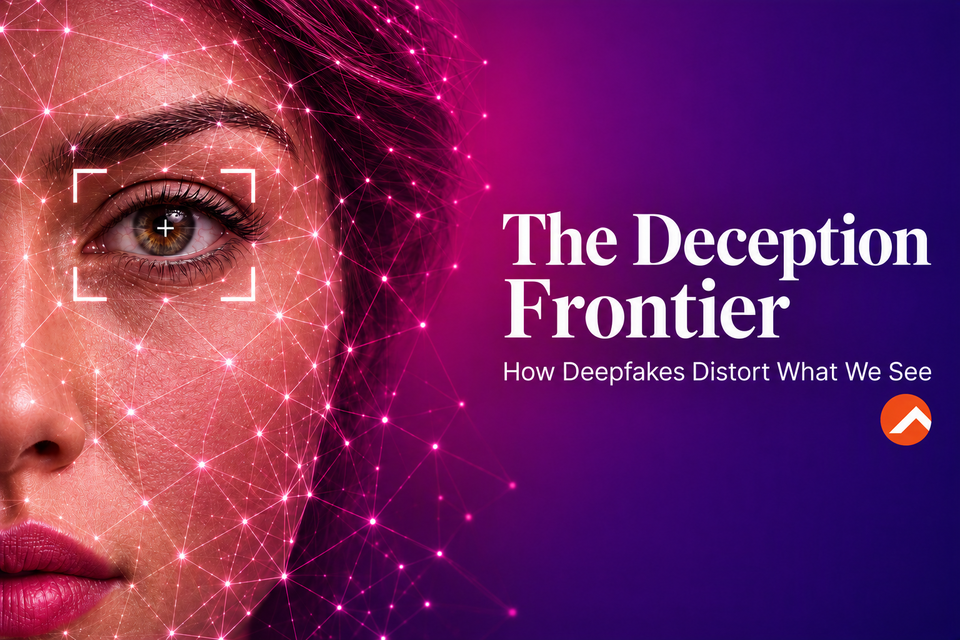
Southeast Asia stands at the vanguard of AI adoption, outpacing nearly every other region. From reimagining customer interactions and automating content workflows to fortifying cybersecurity and revolutionizing banking, institutions are relentlessly expanding the frontiers of what AI can achieve.
The same technology helping businesses innovate is also making it easier for cybercriminals to deceive, manipulate, and steal. In 2026, deepfakes have evolved from an internet curiosity into a very real business threat, affecting organizations across Southeast Asia.
When “Seeing Is Believing” No Longer Applies
A few years ago, spotting a fake video was relatively easy. Today, that’s no longer the case.
One of the most alarming examples came from Hong Kong, where a finance employee attended what appeared to be a routine video call with colleagues and executives. Everything looked normal. The faces were familiar, the voices sounded authentic, and the instructions seemed legitimate. By the time the employee realized the call was fake, more than US$25 million had been transferred.
In Singapore, authorities have also had to respond to AI-generated videos and advertisements using the likeness of public figures to promote fraudulent investment schemes. While the targets may differ, the underlying tactic is the same: exploit trust.
And that’s what makes deepfakes so dangerous. They don’t attack systems first. They attack people.
Why Southeast Asia Is a Prime Target
The region’s rapid digital transformation has created immense opportunities, but it has also expanded the attack surface. Businesses are embracing hybrid work, digital banking, cloud platforms, and AI-powered tools at unprecedented speed. At the same time, cybercriminals now have access to inexpensive AI tools that can clone voices, generate realistic videos, and automate social engineering attacks. Nearly 60% of organizations in Asia Pacific have reported deep-fake driven incidents, while 50% cite reputational damage driven incidents from AI-generated misinformation.
Just imagine attackers; this is a scalable business model. Instead of sending thousands of phishing emails, they can use AI to impersonate a CEO, a supplier, a government official, or even a trusted colleague. The result is a more convincing attack with a much higher chance of success.
The New Strategy: From Detection to Digital Resilience
Many organizations are asking, “How do we detect deepfakes?” A better question might be: “How do we operate safely even when deepfakes exist?“The most resilient organizations are shifting their focus from detection alone to trust verification. “Verify Before You Act” If a request involves money, sensitive data, or critical systems, verification should happen through a separate channel. A phone call, secure messaging platform, or approval workflow can prevent a deepfake-powered scam from becoming a costly incident.
Make Identity the First Line of Defense
Strong authentication, hardware-backed MFA, and identity verification are becoming essential safeguards. In the age of AI impersonation, knowing who is requesting an action is just as important as securing the technology itself.
Train People, Not Just Systems
Employees remain one of the strongest defenses against cyber threats. Organizations should move beyond traditional awareness programs and introduce deep-fake simulations, executive impersonation exercises, and AI-driven fraud scenarios. Building a healthy level of skepticism can significantly reduce risk.
Just as attackers are leveraging artificial intelligence, defenders are doing the same.
AI-powered security tools can help identify manipulated media, detect unusual behavior, and flag suspicious transactions before damage occurs.
Building Skills for the AI Era
Technology alone won’t solve the deep-fake challenge. Organizations also need people who understand how AI changes risk. Across Southeast Asia, demand is growing for AI governance, cybersecurity, and risk management expertise. Training providers such as,
Trainocate is helping businesses strengthen AI and cybersecurity capabilities through programs such as:
- AI for Cybersecurity (TMY-AIC): Applying AI to threat detection, incident response, and security operations.
- Advanced in AI Security Management (AAISM): Focused on AI governance, risk management, and security leadership.
- Advanced in AI Audit (AAIA): Equips auditors and risk professionals to evaluate AI systems and compliance requirements.
These programs reflect a growing reality: defending against AI threats requires both technology and skilled people.
The Road Ahead
Deepfakes are not going away. In fact, they will become more realistic, more accessible, and harder to detect. In an AI-driven era, Southeast Asian organizations are realizing that cybersecurity alone isn’t enough, what’s really at stake is the trust of their stakeholders.
As deepfakes become increasingly sophisticated, organizations need more than awareness. They need tested verification processes, strong identity controls, and employees trained to challenge unusual requests, regardless of who appears to be making them.
The businesses that succeed won’t necessarily be the ones with the most advanced detection tools. They’ll be the ones that combine strong governance, secure processes, skilled employees, and a culture that values verification over assumption.
Building the Workforce Behind Digital Trust
Technology can help detect threats, but people remain at the heart of every effective defense strategy. By strengthening skills in Data, AI, Cybersecurity, and Threat Intelligence, Trainocate empowers organizations to build resilience, foster digital trust, and stay ahead of emerging risks.
In the age of AI, continuous learning isn’t optional. The pursuit of ongoing education is less an elective endeavor than a cornerstone of sustained competitive vitality.
Visit https://trainocate.com to explore our learning solutions.
Or discover Empowered, our digital learning platform offering on-demand training designed for the modern workforce: