AI is reshaping cybersecurity on two fronts at once, strengthening defense while ushering in more sophisticated threats. Splunk’s The CISO Report: From Risk to Resilience in the AI Era, a survey of 650 global CISOs, makes the challenge plain: 95 percent named the growing sophistication of threats a major challenge, and 79 percent said their roles had become considerably more complex.
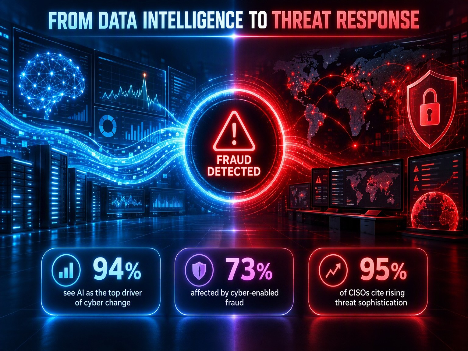
Source- World Economic Forum’s Global Cybersecurity Outlook 2026
1. AI Is Raising the Stakes
AI sharpens detection and automates repetitive work, but threat actors also use it to craft convincing phishing and impersonate trusted individuals. Splunk found that 91 percent of CISOs saw more sophisticated social engineering as a major concern tied to non-agentic AI, with 86 percent concerned about agentic AI. The World Economic Forum’s Global Cybersecurity Outlook 2026 reinforces this: 94 percent of respondents expect AI to be the most significant driver of cybersecurity change, and 87 percent identified AI-related vulnerabilities as the fastest-growing cyber risk during 2025.
2. Governance Cannot Wait
The World Economic Forum found that organizations assessing the security of AI tools nearly doubled, from 37 percent in 2025 to 64 percent in 2026. Yet shadow AI and increasingly autonomous AI agents still call for suitable controls, monitoring and human oversight.
3. The Skills Gap Remains Critical
Technology still relies on people to interpret threats and make decisions. Seventy-nine percent of CISOs expect some or most of their skills gaps to remain unfilled, and among those naming threat hunting as their biggest gap, 71 percent prioritized upskilling existing staff. The answer is to tie training to business goals: assess skills gaps, prioritize critical roles, build structured learning pathways and measure progress.
Where to Start: Courses to Build Your Cybersecurity Skills
Whether you are taking your first step into security or leading an enterprise programme, Trainocate’s official ISC2 training offers a path for every stage of your career.
Certified in Cybersecurity (CC) · 3 days
The entry-level starting point. Build a solid grounding in cybersecurity concepts and prepare for ISC2’s foundational certification. Learn more: https://trainocate.com/courses/isc2/cc-certified-in-cybersecurity-training
Systems Security Certified Practitioner (SSCP) · 5 days
Review and refresh your knowledge, and identify the areas to focus on before the SSCP exam. Learn more: trainocate.com/courses/isc2
Certified Cloud Security Professional (CCSP) · 5 days
Be recognized for cloud security expertise and learn to protect critical assets in the cloud. Learn more: trainocate.com/courses/isc2
Certified Information Systems Security Professional (CISSP) · 5 days
For experienced professionals and security leaders. Covers all eight CISSP domains to help you design, implement and manage a strong cybersecurity programme. Learn more: https://trainocate.com/courses/isc2/ccsp-certified-cloud-security-professional-training
The path from risk to resilience begins with the right skills. As AI continues to transform cybersecurity, organizations that make continuous learning a strategic priority will be better placed to adapt, innovate and protect their digital environments.
Ready to strengthen your team’s cybersecurity skills? Explore Trainocate’s official ISC2 training and find the right course for your workforce at trainocate.com/courses/isc2.