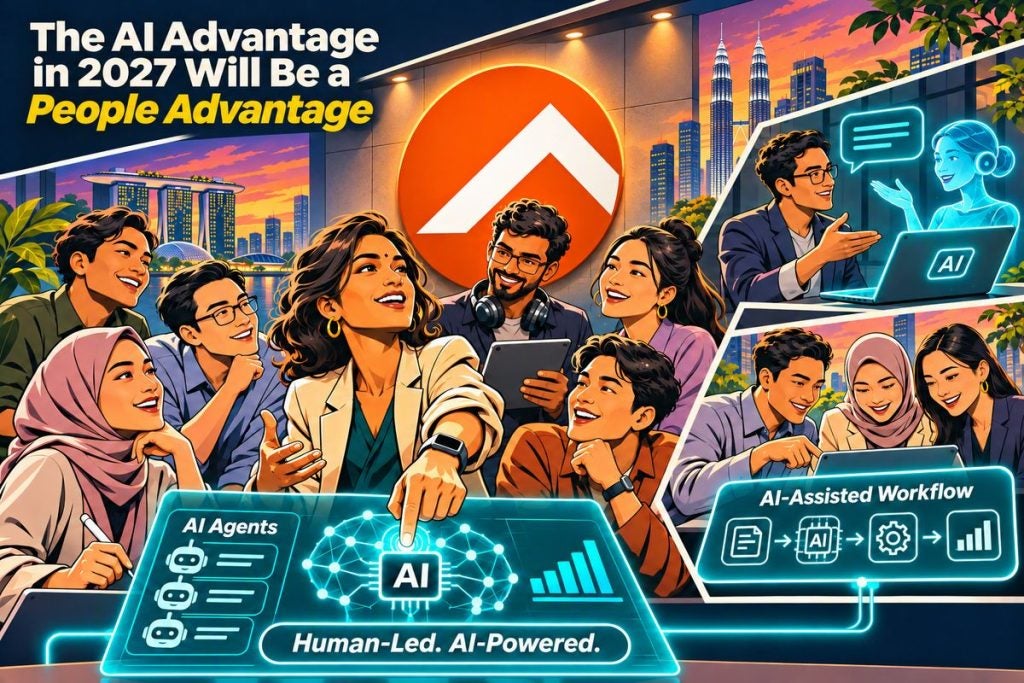
Over the past few years, business conversation around AI has been dominated by possibility. What can we automate? How much time can generative AI save? How quickly can we put these tools into the hands of employees? As we move towards 2027, those questions are changing.
AI is already finding its way into everyday decisions, workflows, customer interactions, software development and productivity. Agentic AI is taking that shift further, moving us from tools that simply respond to prompts towards systems capable of planning, using tools and carrying out multiple steps of work. But something else is becoming clear. As access to powerful AI becomes easier, access itself stops being the advantage.
AI Strategy Is Becoming a Skills Strategy
PwC’s 2025 Global AI Jobs Barometer found that the skills employers are looking for are changing 66% faster in roles most exposed to AI than in roles least exposed to it. It also found a 56% wage premium for workers with advanced AI skills. That tells us something important. AI may automate parts of work, but it is also increasing the value of people who know how to work effectively with it.
What that means will differ from one role to another. A senior leader does not need to know how to train an AI model. They do need to understand where AI can create business value, where investment may not deliver the expected return, what risks come with adoption and which decisions should stay firmly in human hands.
- Managers need to understand how jobs and workflows are changing.
- Developers need deeper skills around models, RAG, agents, security and deployment.
- Governance teams need to think about privacy, bias, accountability and oversight.
- And employees need enough AI fluency to use these tools without assuming that a confident-looking answer is necessarily a correct one.
AI Fluency Will Not Look the Same for Everyone
As AI moves from answering questions and generating content to taking action, making decisions and working across systems, organisations face a much bigger challenge than adoption. They need to rethink roles, responsibilities and the skills people will need to work alongside increasingly capable AI. This is also why a one-size-fits-all approach to AI training is unlikely to create a truly AI-ready organisation.
A CEO, marketer, project manager and AI engineer may all work with AI, but they will engage with it in very different ways. The skills they need should reflect the decisions they make, the work they do and the responsibilities they carry.
- Leaders need the fluency to connect AI with business strategy, evaluate opportunities and investments, and navigate governance, risk and responsible adoption.
- Business users need practical confidence in using AI effectively, from prompting and everyday productivity to validating outputs and using AI responsibly.
- Developers need deeper technical capabilities to build with AI, including models, retrieval-augmented generation (RAG), agents, security, integration and deployment.
- AI and ML specialists need advanced expertise in model evaluation and optimisation, operationalising AI systems, monitoring performance and managing AI reliably in production.
From AI Awareness to AI Capability
What should people learn? That depends on where they sit in the organisation and what they need to accomplish.
1. Executives and Business Leaders
Senior leaders need enough AI fluency to make better decisions about AI, not necessarily build it themselves. That includes understanding where AI creates meaningful value, how to evaluate investment, where implementation can fail and what responsible adoption looks like.
For AWS environments, AWS Certified AI Practitioner (AIF-C01) provides a useful route for professionals who work with or make decisions around AI without necessarily developing complex AI systems themselves.
Trainocate’s AWS learning portfolio also includes Generative AI for Executives, alongside business strategy-oriented AI learning. Next for Google Cloud environments, Generative AI Leader takes a similarly business-focused approach, covering generative AI fundamentals, Google Cloud capabilities and how organisations can translate AI technology into business outcomes.
2. Employees Beginning Their AI Journey
Not everyone needs to start with a certification. In most of the organisations, the first step is simply building confidence. Employees need to understand what AI is good at, where it struggles, how to communicate effectively with it and how to check what it produces.
Trainocate’s AWS pathways include an AI Novice track for technical and non-technical professionals beginning their AI journey. Trainocate Empowered also provides learning around areas such as AI for Business Enablement & Leadership, Prompt Engineering for Executives & End Users, and Microsoft Copilot and agentic AI.
3. Microsoft Azure AI Professionals
As for professionals working within Microsoft Azure, the journey becomes progressively more technical.
Trainocate’s current portfolio includes:
- AI-901T00: Introduction to AI in Azure
- AI-103T00: Develop AI Apps and Agents on Azure
- AI-300T00: Operationalize Machine Learning and Generative AI Solutions
More focused learning includes programmes such as AI-3016: Develop Generative AI Apps in Azure and AI-3019: Build AI Apps with Azure Database for PostgreSQL.
Someone beginning with AI foundations needs a very different learning experience from a developer building agents or a specialist operationalizing AI system in production.
4. AWS Developers and AI Specialists
For professionals building with AI rather than simply using it, the skills requirement changes again. Trainocate’s AWS portfolio includes Developing Generative AI Applications on AWS, with learning progressing into deeper generative and agentic AI specialisation.
At an advanced level, AWS Certified Generative AI Developer – Professional (AIP-C01) covers areas involved in developing production generative AI solutions, including foundation models, RAG, vector stores, prompt engineering, agentic AI, security, evaluation, monitoring and cost optimisation. Trainocate also includes Agentic AI Foundations for professionals beginning to move towards agent-based architectures.
5. Google Cloud AI Practitioners
Google Cloud offers similarly varied entry points depending on the learner’s responsibilities. Trainocate’s current learning portfolio includes Generative AI Leader, Generative AI in Production, Introduction to AI and Machine Learning on Google Cloud, and Data Engineering on Google Cloud Platform. Technical practitioners can progress further into technologies such as Gemini and Vertex AI as they begin developing, deploying and managing AI applications.
At Trainocate, that is where AI transformation meets learning. Through role-based pathways across AI, cloud, data, cybersecurity and emerging technologies, organisations can build capability around the people, platforms and business outcomes that matter to them. With learning spanning Microsoft, AWS, Google Cloud and other technology ecosystems, the goal is not just to help people understand AI. It is to help them apply it confidently, responsibly and effectively in the work they actually do.
Whether your organisation is starting with AI literacy, preparing leaders to make better AI decisions or developing technical teams capable of building production AI and agents, the learning journey should begin with the role, the skills and the outcome.
Explore Trainocate’s AI learning pathways and turn AI ambition into workforce capability.
Learn. Apply. Validate. Advance. Repeat.