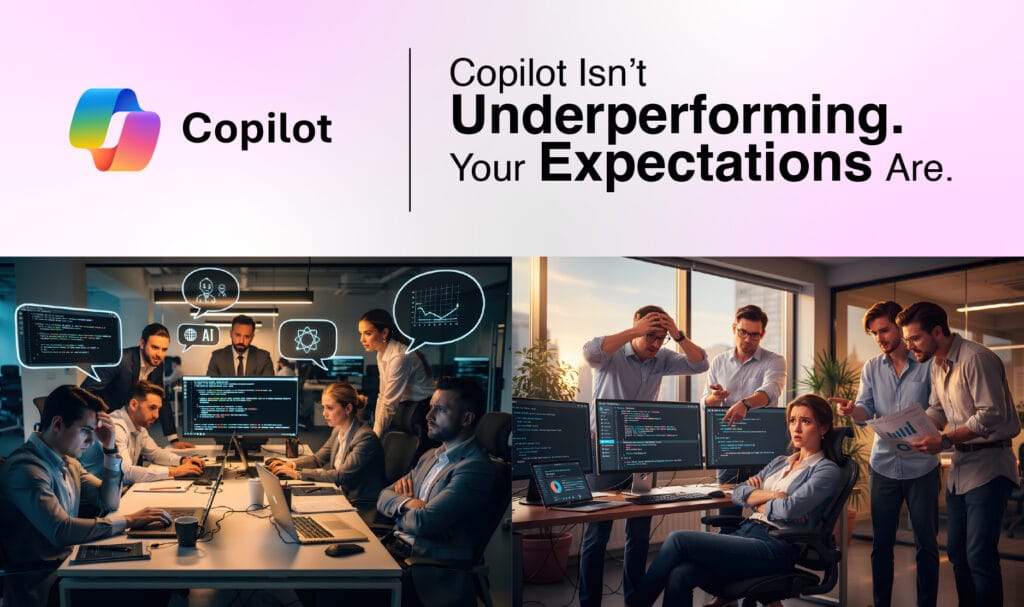
Most organizations aren’t misusing Microsoft Copilot. They’re underestimating it. Copilot is often treated as a smarter search engine, a faster junior assistant, or a novelty that drafts emails a little better than humans. Meetings are summarized faster. Emails are written quicker and documents are polished in minutes. But those gains are marginal. When Copilot is confined to surface-level use, organizations achieve incremental efficiency, not transformation. The issue lies not with the technology, but with how it is expected to perform.

The Comfort Zone of Conversation
Standard Microsoft Copilot operates primarily as a conversational AI. You ask a question, it responds. You prompt it to draft, summarize, rephrase, or retrieve information. These capabilities are powerful and undeniably useful in day-to-day work. Yet conversational AI comes with an inherent limitation.
Every outcome still depends on a human to:
- Ask the right prompt
- Interpret the response
- Decide what to do next
- Manually move the work forward
Copilot, in this mode, accelerates tasks but it doesn’t remove friction. Work still moves step by step, person by person, handoff by handoff. The AI is fast, but the workflow is not. That’s why productivity gains often plateau quickly.
The Shift Organizations Are Missing
This is where many organizations stop looking but where the real opportunity begins. Copilot Agents are not an upgrade. They represent a fundamental shift in how work gets done. Agents don’twait for prompts. They don’t sit idle until someone asks a question. Instead, they operate on defined outcomes and conditions. You don’t ask them to help. You design what success looks like, and they execute when triggers occur.
From Assistance to Execution
Consider a familiar enterprise scenario, incoming proposals. In most organizations, proposals arrive and sit idle. Eventually, someone reviews them, summarizes the content, checks alignment with requirements, flags risks, routes them for approval, follows up with stakeholders, and logs the activity. Each step is manual, and each handoff introduces delay. With Copilot Agents, this entire workflow can be automated:
- Proposals are detected the moment they arrive
- Content is summarized and evaluated against predefined criteria
- Gaps and risks are flagged automatically
- Approvals are routed to the right stakeholders
- Actions are logged without human intervention
The AI is fast, but the workflow is not.
No waiting. No chasing. No bottlenecks.
Why Expectations Matter More Than Tools
When organizations say Copilot hasn’t delivered the impact they expected, what they often mean is this:
” We applied a transformational tool to incremental problems.“
Copilot is not just an efficiency layer. It’s an operating model shift. But to unlock that shift, teams must move beyond curiosity and experimentation toward real application, and that transition doesn’t happen automatically.
This isn’t about learning what AI can do. It’s about learning how to apply it where it matters most.
The Real Question Organizations Should Be Asking
Are organizations ready to:
- Redesign workflows instead of optimizing tasks
- Trust AI with execution, not just suggestions
- Invest in skills that move beyond prompting into orchestration
Because when Copilot is allowed to operate at its full potential through agents, automation, and outcome-driven design, it doesn’t just save time, it changes how work flows.
Recommended Training Programs That Actually Drive Transformation
In order to, move from assistance to execution, organizations need a layered approach, these are some of the useful training programs.
1. MS-4014 – Copilot for Microsoft 365: The Foundation
A foundational entry point for Copilot for Microsoft 365 represents the entry point for most organizations AI journeys. This need to be seamlessly integrated into familiar applications such as Word, Excel, PowerPoint, Outlook, and Teams. At this stage, the focus centers on cultivating strong prompting techniques and effectively leveraging AI for content generation and summarization.
2. MS-4022 – Extend Microsoft 365 Copilot in Copilot Studio
Copilot Studio represents the pivotal progression in the Copilot journey, marking a shift from assisted productivity to intelligent, outcome-driven automation. At this stage, the focus expands to designing and deploying Copilot agents, orchestrating trigger-based workflows, and integrating seamlessly with enterprise data sources.
3. PL-7008: Create agents in Microsoft Copilot Studio
This course focuses more on building and deploying AI-powered agents using Microsoft Copilot Studio, covering topics like conversation design, generative AI, and automation. It’s a hands-on applied skills credential that validates your ability to create, manage, and enhance intelligent conversational copilots for business scenarios.
Check out our website for more details:- https://trainocate.com
Explore Your Learning Journey with Empowered On-Demand
Empowered On-Demand offers a guided, structured approach to learning, supporting individuals as they progress from foundational knowledge to advanced, industry-relevant expertise. With clearly defined learning pathways, learners can confidently build skills, earn certifications, and stay competitive in today’s fast-evolving digital landscape.Step into Empowered and discover career-ready learning designed for your growth.
Find out more: https://marketing.trainocate.com/empowered
Cut the noise. Master the skills. Elevate how you learn.