
There was a time when fraud followed predictable patterns. A suspicious email landing in an inbox. A stolen password used after business hours. An unexpected transaction flagged from a foreign country. These were the hallmarks of an earlier era, one where criminals operated with limited scope and relatively unsophisticated methods.
Today’s fraud landscape bears little resemblance to what came before. Artificial intelligence has fundamentally altered the balance of power, giving criminals capabilities. The contest is no longer between fraudsters and security teams; it has become a battle between intelligent systems, where AI serves both sides with equal effectiveness.
The New Face of Fraud
Imagine receiving a video call from your Chief Financial Officer. The request seems urgent; a transfer to close a confidential acquisition. The face on the screen is familiar. The voice is unmistakable. The context is entirely plausible; everything appears authentic, but none of it is real.
The rapid advancement of generative AI and deepfake technologies has dramatically lowered the barriers to creating convincing synthetic identities. Fraudsters can now replicate voices, facial expressions, communication styles, and even professional mannerisms with startling accuracy. According to the 2026 Anti-Fraud Technology Benchmarking Report by Association of Certified Fraud Examiners, Inc., 77% of anti-fraud professionals reported an increase in deepfake-powered social engineering attacks, making it one of the fastest-growing fraud threats globally. Trust, which is one of the most human of instincts has become increasingly difficult to verify.
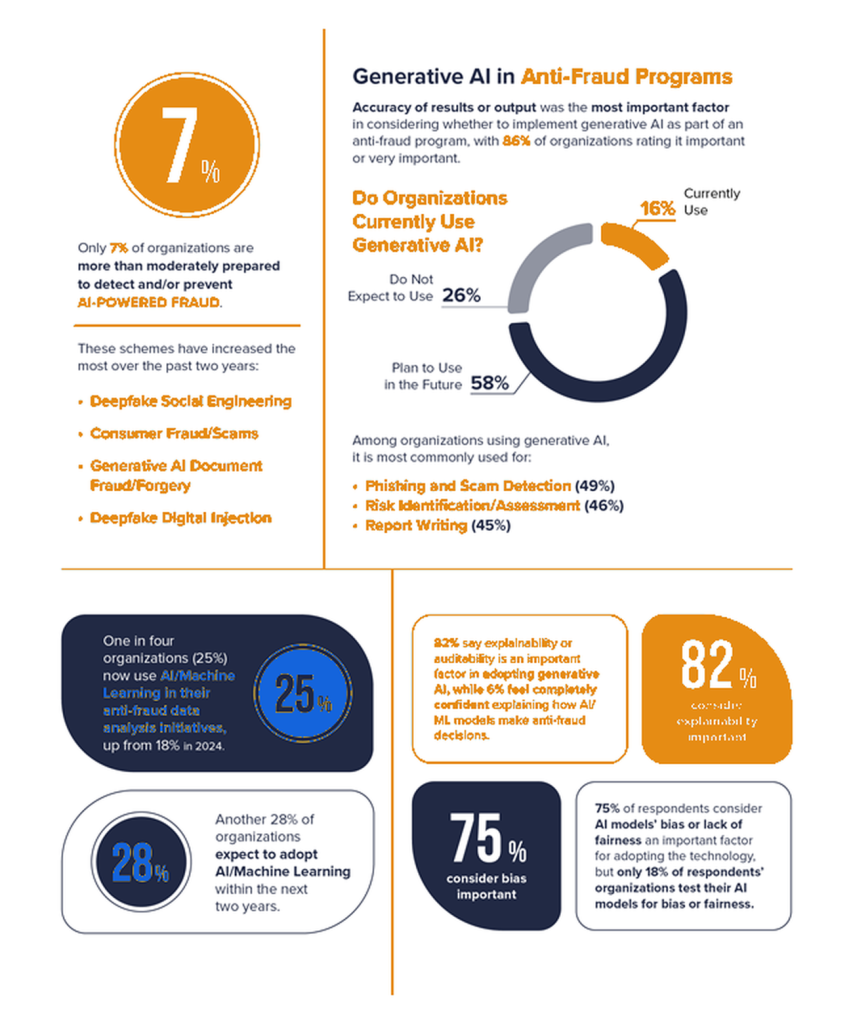
Source from Association of Certified Fraud Examiners, Inc.
The Cost of Falling Behind
The business implications are significant and growing. According to industry forecasts, the global fraud detection and prevention market is expected to grow from USD 41.8 billion in 2024 to USD 85.2 billion by 2030—a clear reflection of the urgency with which organizations are investing in advanced capabilities. Research from the Association of Certified Fraud Examiners (ACFE) and SAS found that only 25% of organizations currently use AI and machine learning within their fraud prevention programs, even as AI-enabled threats continue to accelerate. This disconnect reveals a critical challenge that too few leaders are willing to confront. Organizations are not competing against a technology problem. They are competing against a skills problem.
Technology Alone Is Not Enough
Many businesses assume that purchasing an AI-powered fraud solution is sufficient protection. The vendor promises sophisticated algorithms, real-time detection, and automated responses. The box is checked, and the board is satisfied. The reality is considerably more complex.AI systems must be trained, monitored, governed, and continuously optimized. They require professionals who understand data, risk management, cybersecurity, machine learning, and regulatory compliance. These are not skills that can be purchased off the shelf.
An AI model may detect an unusual transaction pattern. It takes a skilled analyst to determine whether it signals organized criminal activity, a loyal customer’s changing behavior, or a legitimate commercial event. Thisdistinction matters enormously.
Without the necessary expertise, organizations risk generating excessive false positives, frustrating legitimate customers, and weakening trust—while simultaneously failing to detect sophisticated threats. Theeffectiveness of AI is ultimately determined by the capabilities of the people overseeing it.

How Trainocate Helps Organizations Build Fraud Resilience
As fraud becomes increasingly intelligent, organizations require more than technology implementation; they require workforce transformation. Trainocate enables organizations to develop the Data, AI, Cloud, and Cybersecurity capabilities necessary to strengthen fraud prevention strategies and create resilient digital operations. Through globally recognized certification pathways and hands-on learning experiences, professionals can build expertise in:
Data and AI: The Foundation of Intelligent Detection
Fraud detection starts with data and the ability to read it, analyze it, and act on it. These courses empower your teams to uncover hidden patterns, detect anomalies, and transform raw information into actionable intelligence.
Microsoft Fabric
Implement Real-Time Intelligence with Microsoft Fabric (DP-603) – Learn to ingest, transform, and analyze streaming data with Microsoft Fabric.
Microsoft Fabric Data Engineer
Microsoft Fabric Data Engineer (DP-700) – This course covers methods and practices to implement data engineering solutions using Microsoft Fabric, including designing and developing effective data loading patterns, data architectures, and orchestration processes.
AWS Machine Learning
Machine Learning Engineering on AWS (AWS-MLE) – A 3-day intermediate course for ML professionals to learn to build, deploy, orchestrate, and operationalize ML solutions at scale. Participants gain practical experience using AWS services such as Amazon SageMaker AI and Amazon EMR.
Cybersecurity and Threat Intelligence
Modern fraud often intersects with cybersecurity. Trainocate’s cybersecurity portfolio—including CISSP, CISM, Security Operations, Cloud Security, Identity and Access Management, and Threat Intelligence programs, equips professionals with the knowledge required to detect, investigate, and mitigate increasingly sophisticated attacks.
Cybersecurity Foundations (ATC-CSF)
Cybersecurity Foundations ( ATC-CSF) course provides a global perspective on designing secure systems, covering current threat trends, compliance requirements, and hands-on experience with live viruses including botnets, worms, and Trojans. Participants learn risk management, threat determination, disaster recovery, security policy management, and business continuity planning. This course provides an excellent foundation for those proceeding to CISSP, CEH, CISA, or CISM training.
CompTIA Security+
CompTIA Security+ cybersecurity certification covers risk management, security operations, and core security concepts. It is widely recognized across industries including government, financial services, healthcare, and enterprise IT environments.
Certified Cyber Threat Intelligence Analyst (CCTIA)
CCTIA course introduces threat intelligence concepts and takes participants through the entire process of setting up a Threat Intel Platform using MISP to consume intelligence from over 80 global community feeds. Participants also learn to share intelligence on malware and attacks back to the community. Certification is provided through Global ACE Certification.
ISACA Advanced in AI Security Management (AAISM)
AAISM is the first AI-centric security management certification designed for experienced IT professionals. It validates expertise in managing evolving security risks related to AI, implementing policy, and ensuring responsible AI use across the organization. Prerequisites include holding a CISM or CISSP certification.
From Intelligence to Impact
By building capabilities across Data, AI, Cybersecurity, and Threat Intelligence, Trainocate empowers organizations to stay ahead of evolving threats with confidence. Because in an age of intelligent machines, the greatest defense is still an intelligent workforce. Unlock your full potential through lifelong learning.
Contact us for more info: https://trainocate.com and be sure to check out our Empowered site for a full lineup of on-demand courses and training programs.
Learn more now: https://marketing.trainocate.com/empowered